Monday, 8 October 2012

Saturday, 6 October 2012
Andy's Reply to Shawn's E-mail Offer : Ducati Monster 795
Dear Shawn,
Thank you for your interest in my blog and your kind offer.
I must say that I am rather tempted by your offer, especially since I have always like Italian rides and the Monster being one of my fave streetfighter bikes. In fact, I was looking to purchase the ER6N (ala Monster) but switched to the ER6F pursuant to the further advices.
Yes, my ER6F is the Japan CBU version; and I have heard from my mechanic that it has lesser engine vibration compared to the CKD models, and is more "solid". To me though, I thought that the CBU and CKD are about the same; but whom am I to argue with the pros.
The Japan CBU version sold at RM45k, and I have since added aftermarket branded accessories amounting to RM10k to have an even better ride. Mine is a real ride-and-enjoy bike from the word "Go!".
Let me think about your offer. I am tempted for the Monster looks, but I also very much like my Green Hornet for the bike that it is. Thus far, my bikes have all been of Kawasaki make due to the easy maintenance and reliability of the marque.
I'll come back to you on the matter.
Thanks, mate!
Cheers,
Andy


Thank you for your interest in my blog and your kind offer.
I must say that I am rather tempted by your offer, especially since I have always like Italian rides and the Monster being one of my fave streetfighter bikes. In fact, I was looking to purchase the ER6N (ala Monster) but switched to the ER6F pursuant to the further advices.
Yes, my ER6F is the Japan CBU version; and I have heard from my mechanic that it has lesser engine vibration compared to the CKD models, and is more "solid". To me though, I thought that the CBU and CKD are about the same; but whom am I to argue with the pros.
The Japan CBU version sold at RM45k, and I have since added aftermarket branded accessories amounting to RM10k to have an even better ride. Mine is a real ride-and-enjoy bike from the word "Go!".
Let me think about your offer. I am tempted for the Monster looks, but I also very much like my Green Hornet for the bike that it is. Thus far, my bikes have all been of Kawasaki make due to the easy maintenance and reliability of the marque.
I'll come back to you on the matter.
Thanks, mate!
Cheers,
Andy
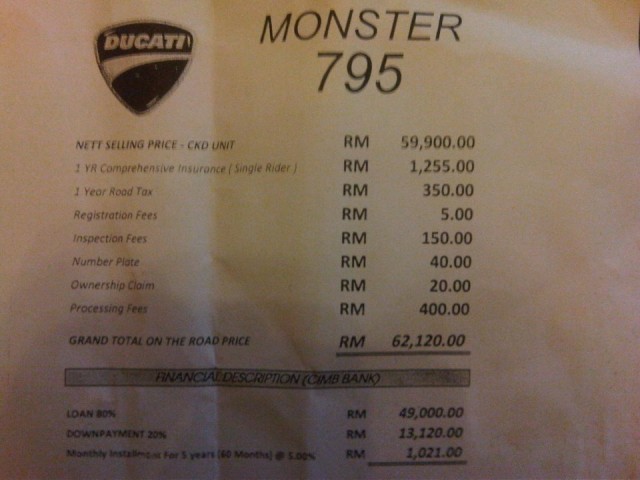


Shawn's E-mail Offer : Ducati Monster 795
Dear Andy,
I recently bought a Ducati M795 CBU Thailand for RM60k. I am the first owner. The reason I bought the M795 was because I was interested to get a 2-wheeler after following your blog for a few months now; and the shop owner recommended the Ducati as he told me that the ER6 (I went to look at the ER6F) was common as heck. I was sold on his words on exclusivity and Italian-crafted precision machinery and bought the M795.
However, I find that the bike was not so suitable for me. I tried my hands on a fellow rider's ER6F and was delighted to find that it's such an easily-controllable bike, just nice for me.
I like to make you an offer. Let's swap our bikes. I know from the earlier postings that yours was the CBU Japan version- the shop owner told me previously that the CBU had lesser vibration compared to the CKD model. My M795 is nearly brand new and has 10k mileage. You just top-up RM15k and hand-over your ER6F with all the installed accessories, and we'll go to JPJ together to effect the change in ownership.
Okay?
Best regards,
Shawn
I recently bought a Ducati M795 CBU Thailand for RM60k. I am the first owner. The reason I bought the M795 was because I was interested to get a 2-wheeler after following your blog for a few months now; and the shop owner recommended the Ducati as he told me that the ER6 (I went to look at the ER6F) was common as heck. I was sold on his words on exclusivity and Italian-crafted precision machinery and bought the M795.
However, I find that the bike was not so suitable for me. I tried my hands on a fellow rider's ER6F and was delighted to find that it's such an easily-controllable bike, just nice for me.
I like to make you an offer. Let's swap our bikes. I know from the earlier postings that yours was the CBU Japan version- the shop owner told me previously that the CBU had lesser vibration compared to the CKD model. My M795 is nearly brand new and has 10k mileage. You just top-up RM15k and hand-over your ER6F with all the installed accessories, and we'll go to JPJ together to effect the change in ownership.
Okay?
Best regards,
Shawn
The Danger of Flip-up Helmets - real account
http://motorcycleinfo.calsci.com/Green.html
In spring of '04 a friend of mine set out on a CC50 - coast to coast in 50 hours, Jacksonville to San Diego. On the first day of his trip he had a crash. He woke up four days later in the hospital with no memory of crashing. He's still not sure what happened - the police report shed no light on the subject.
He was in the hospital for over a month, with a concussion, a broken eye socket, five broken ribs and a badly damaged hand.He's substantially recovered now. He was wearing a flip-open helmet (picture below) which seems substantially unharmed, especially in view of the beating his head took. This case is one reason I recommend avoiding these helmets.
This being America, while he was in his hospital bed still confused from the concussion, his "wife" served him divorce papers.

Before - all fit out for Iron Butt events
Mast with Otter Box on top containing V-1, Other side is C/B Ant. Ron Smith Aux. Fuel Tank.On saddle bag is 12" Red LED which is turn signal/running light. Forward of saddle bag is mount for one gallon jug of water.Just under PIAA 910 is a 6" Amber turn signal/running light.

Instruments for Iron Butt events
On top of shelf is Garmin 2610 GPS. Directly below is the V-1 indicator.To the left is the control head for the radio wrapped in "Tank Slapper" material.On the left handle bar is the control for the Cruise Control. The Yellow & Red s/w are for future use.Switch box controls PIAA 910 & 1400, V-1, Heated Seat, Volt Meter & socket.The black box on top controls Gate Opener, Garage Door, and two for heated clothing.


Although the helmet shows little sign of a major impact, my friend was in a coma for three days, and required multiple surgeries to repair his eye sockets and get his eyes to stay in his head. He was also mentally confused for a couple of weeks. The helmet is a Nolan flip-open helmet. Normally, one expects a helmet to protect your head in a crash; in this case it seems my friend's head protected the helmet. I believe the hinge mechanism hit his temple, causing the eye socket damage and severe concussion. For this reason, I believe flip-open helmets are dangerous and should be avoided.
In spring of '04 a friend of mine set out on a CC50 - coast to coast in 50 hours, Jacksonville to San Diego. On the first day of his trip he had a crash. He woke up four days later in the hospital with no memory of crashing. He's still not sure what happened - the police report shed no light on the subject.
He was in the hospital for over a month, with a concussion, a broken eye socket, five broken ribs and a badly damaged hand.He's substantially recovered now. He was wearing a flip-open helmet (picture below) which seems substantially unharmed, especially in view of the beating his head took. This case is one reason I recommend avoiding these helmets.
This being America, while he was in his hospital bed still confused from the concussion, his "wife" served him divorce papers.
Here's his Honda ST1300 before:
Before - all fit out for Iron Butt events
Mast with Otter Box on top containing V-1, Other side is C/B Ant. Ron Smith Aux. Fuel Tank.On saddle bag is 12" Red LED which is turn signal/running light. Forward of saddle bag is mount for one gallon jug of water.Just under PIAA 910 is a 6" Amber turn signal/running light.
Instruments for Iron Butt events
On top of shelf is Garmin 2610 GPS. Directly below is the V-1 indicator.To the left is the control head for the radio wrapped in "Tank Slapper" material.On the left handle bar is the control for the Cruise Control. The Yellow & Red s/w are for future use.Switch box controls PIAA 910 & 1400, V-1, Heated Seat, Volt Meter & socket.The black box on top controls Gate Opener, Garage Door, and two for heated clothing.
Here's his Honda ST1300 after:
Although the helmet shows little sign of a major impact, my friend was in a coma for three days, and required multiple surgeries to repair his eye sockets and get his eyes to stay in his head. He was also mentally confused for a couple of weeks. The helmet is a Nolan flip-open helmet. Normally, one expects a helmet to protect your head in a crash; in this case it seems my friend's head protected the helmet. I believe the hinge mechanism hit his temple, causing the eye socket damage and severe concussion. For this reason, I believe flip-open helmets are dangerous and should be avoided.
The Danger of Flip-up Helmets - real account
http://www.advrider.com/forums/showthread.php?t=149762
Was tempted not to post this report as I really do not like to make myself look like an idiot. But something may be learned from it so here goes. Pretty weak on exciting crash pics as it happened at night so you will have to bear mostly with my scintillating prose. Had left Bangkok early to head up to Chiang Mai with my newest Africa Twin. Smooth ride, about 8 hours. Once there did a bit of work and then jumped on my KTM. Plan was to ride about 5 hours east to a small town called Dan Sai to meet my friend David Unkovich for a festival there. Did not leave until about 5 o'clock in the afternoon so knowingly went into the ride with night time riding hours ahead...... Had been on most of the road before so was not really worried about it. About half the way over I decided to take a shortcut over the mountains as it would cut off a lot of time. It was a good two lane highway with very limited traffic. Was about 25 kilometers away from Dan Sai and riding a bit ( ??? ) faster than I should have. Because of the darkness was a bit more difficult to judge speed. Came up over a rise, and then there was long slightly downhill section where my speed picked up unknowingly to me. Next thing I know there is a slight right hand curve at the end of the straight away. Looking at the site the next day did not seem like much of a curve......Made the wrong decision to scrub speed before entering the curve . Because of the dark I could not see how tight it was and did not want to take a chance. There are many turns on Asian roads that are decreasing radius. This was not one of them.
Was in a sort of forested area with underbrush along the side of the road. All along the outside of the turn were three foot high cement posts spaced about every couple of yards. Locked the wheel briefly which started to fishtail the rear. Figured I would be better off going into them with some control instead of sliding into them. My last thought before I hit them at perhaps 100 kph was that I was well and truly fucked this time.
Woke up in the dark, in pain beyond belief, broken motorcycle bits all around me, the front of my helmet smashed off, and unable to get up. The bike was lying 5 meters away with the headlight still on pointing away from me. My right eye was almost swollen shut, and my back felt like the mafia spent a day working me over with base ball bats. Did not even know where the road was, but cleverly reasoned it must be above me. So crawled on my hands and knees up to the road and and waited long periods until a car would come by. Tried to sort of crouch upright and wave my broken helmet at cars to get them to stop. At this time was about 10 pm at night. No one would stop. Realized at this point things were getting a bit serious as the bike could not be seen from the road, and I was worried about going into shock from the pain. Crawled back to the bike to get the flash light from the tank bag and went back to the road. Now finally a truck full of local villagers stopped when they saw me waving the flashlight . They did not speak a word of english, and my Thai was not working too well as they spoke a local dialect. My phone, cash, and passport were in a fanny pack which was located in my left side Jesse bag. That bag took a direct hit on one of the posts, was smashed open, and all the contents strewn over the underbrush. Potentially a ugly scene as I cannot communicate what I wish to the the villagers, which is to sort of secure the bike and get to the hospital in Dan Sai before I pass out. In my fogged out brain I realize I must find the small green fanny pack to get the ball rolling because of the phone.
At this point I can stand a little bit with lots of pain. So in a sort of comedy scene myself and some of the villagers scour all around for 15 minutes until I find the green bag in the green underbrush. Thank god, phone time!! A quick call to my friend David, who speaks very good Thai and now things were rolling. Sorted out a local guy to spend the night with the bike, jumped into
their truck, and then off to the Dan Sai hospital where David was
waiting for me to show up. It was about 25 kilometers further down the
road. A very nice small regional hospital, much better than you would
expect in a small town. Took pelvic x rays which showed nothing broken.
Had a huge black eye from the helmet coming apart and my face hitting
something. Looking at the helmet I think I think my face went into one
of the posts. Had lots and lots of pain as well. My back looked like it
had only a small bruise on it while at the hospital. Was not until the
next day my whole ass turned blue....
Sorted out a local guy to spend the night with the bike, jumped into
their truck, and then off to the Dan Sai hospital where David was
waiting for me to show up. It was about 25 kilometers further down the
road. A very nice small regional hospital, much better than you would
expect in a small town. Took pelvic x rays which showed nothing broken.
Had a huge black eye from the helmet coming apart and my face hitting
something. Looking at the helmet I think I think my face went into one
of the posts. Had lots and lots of pain as well. My back looked like it
had only a small bruise on it while at the hospital. Was not until the
next day my whole ass turned blue....
Spent the night there, and then called another friend of mine named David who was in Chiang Mai. Sorted him to come out in my truck and pick me up along with the broken bike. He showed up in the afternoon, so all of us then went out to the crash site. The local guy was still waiting there the next day, and he had carefully covered the bike up. Bike was sitting upright from salvage effort from the night before, so just sort of dragged it up the embankment onto the road, and then dead lifted it ( not me ) into the truck. By this time a sort of crowd of local villagers had gathered. They were looking at the cement posts that were knocked over and the smashed up bike, and kept asking her where the dead foreigner was. When my girlfriend pointed to me helping to load the bike onto the truck , they just shook their heads and kept saying amazing that I had life in me. Think they are right. And by the way there was no drinking involved !!!
Lessons???
1. No fool like an old fool
2. Do not ride at night
3. Ride fast for what???
4. Riding alone adds to risks if problems come up
5. 13 hours of riding on short sleep dramatically affects judgement
Pictures....
My 700 baht a night hospital room ( about $ 18......) Complete with
smiling nurses !
Humor is where you find it.I had originally asked for a private room for the whopping cost of 700 baht. However there were only stairs going up to the private rooms on the second floor. Sooo I had to try to walk up them. The whole time in the emergency room I had been lying face down on the gurney. So the attendant ( loose usage of the word ) guy pushes me to the base of the stairs. Partly in shock, injected with pain killer,and lying down for hours I tried to suddenly stand up and walk up the stairs...... Hmmmmmm
I made it up one stair before I was a whisker away from pass out time. Now cannot even get back on the gurney. Had to muster strength just to get back on it. Now rolled back to the public ward full of drunks from the festival in town. The guy lying next to me keeps asking the nurse for whiskey.
Realized that I had transitioned too quickly from horizontal to vertical. Now this time sat up in bed for a while until I felt better, then was able to make it up the stairs to my luxury room.
The look of pain the next day on David's bike in front of the hospital.
The next day recovering the bike.
No ramp needed, just lots of local muscle.
Looking into the curve. You see the missing posts that I knocked down, and the cement stripped from the one I hit first. Think that was the one that killed my Jesse box.
Yeah I took some pain, but I kicked some butt on that post.
Part of the pain.
More pain. Am lucky to have two eyes.
Hey let's throw in a broken toe too !!!
Helmet WAS a Schuberth Concept. Always liked it for touring due to
the flip up design, good for tropical heat. Think my face went into one
of the posts after looking at all the scratches on the front. Was disappointed
seeing the front break off, somehow thought they would be tougher.
Close up.
Was tempted not to post this report as I really do not like to make myself look like an idiot. But something may be learned from it so here goes. Pretty weak on exciting crash pics as it happened at night so you will have to bear mostly with my scintillating prose. Had left Bangkok early to head up to Chiang Mai with my newest Africa Twin. Smooth ride, about 8 hours. Once there did a bit of work and then jumped on my KTM. Plan was to ride about 5 hours east to a small town called Dan Sai to meet my friend David Unkovich for a festival there. Did not leave until about 5 o'clock in the afternoon so knowingly went into the ride with night time riding hours ahead...... Had been on most of the road before so was not really worried about it. About half the way over I decided to take a shortcut over the mountains as it would cut off a lot of time. It was a good two lane highway with very limited traffic. Was about 25 kilometers away from Dan Sai and riding a bit ( ??? ) faster than I should have. Because of the darkness was a bit more difficult to judge speed. Came up over a rise, and then there was long slightly downhill section where my speed picked up unknowingly to me. Next thing I know there is a slight right hand curve at the end of the straight away. Looking at the site the next day did not seem like much of a curve......Made the wrong decision to scrub speed before entering the curve . Because of the dark I could not see how tight it was and did not want to take a chance. There are many turns on Asian roads that are decreasing radius. This was not one of them.
Was in a sort of forested area with underbrush along the side of the road. All along the outside of the turn were three foot high cement posts spaced about every couple of yards. Locked the wheel briefly which started to fishtail the rear. Figured I would be better off going into them with some control instead of sliding into them. My last thought before I hit them at perhaps 100 kph was that I was well and truly fucked this time.
Woke up in the dark, in pain beyond belief, broken motorcycle bits all around me, the front of my helmet smashed off, and unable to get up. The bike was lying 5 meters away with the headlight still on pointing away from me. My right eye was almost swollen shut, and my back felt like the mafia spent a day working me over with base ball bats. Did not even know where the road was, but cleverly reasoned it must be above me. So crawled on my hands and knees up to the road and and waited long periods until a car would come by. Tried to sort of crouch upright and wave my broken helmet at cars to get them to stop. At this time was about 10 pm at night. No one would stop. Realized at this point things were getting a bit serious as the bike could not be seen from the road, and I was worried about going into shock from the pain. Crawled back to the bike to get the flash light from the tank bag and went back to the road. Now finally a truck full of local villagers stopped when they saw me waving the flashlight . They did not speak a word of english, and my Thai was not working too well as they spoke a local dialect. My phone, cash, and passport were in a fanny pack which was located in my left side Jesse bag. That bag took a direct hit on one of the posts, was smashed open, and all the contents strewn over the underbrush. Potentially a ugly scene as I cannot communicate what I wish to the the villagers, which is to sort of secure the bike and get to the hospital in Dan Sai before I pass out. In my fogged out brain I realize I must find the small green fanny pack to get the ball rolling because of the phone.
At this point I can stand a little bit with lots of pain. So in a sort of comedy scene myself and some of the villagers scour all around for 15 minutes until I find the green bag in the green underbrush. Thank god, phone time!! A quick call to my friend David, who speaks very good Thai and now things were rolling.
Sorted out a local guy to spend the night with the bike, jumped into
their truck, and then off to the Dan Sai hospital where David was
waiting for me to show up. It was about 25 kilometers further down the
road. A very nice small regional hospital, much better than you would
expect in a small town. Took pelvic x rays which showed nothing broken.
Had a huge black eye from the helmet coming apart and my face hitting
something. Looking at the helmet I think I think my face went into one
of the posts. Had lots and lots of pain as well. My back looked like it
had only a small bruise on it while at the hospital. Was not until the
next day my whole ass turned blue....Spent the night there, and then called another friend of mine named David who was in Chiang Mai. Sorted him to come out in my truck and pick me up along with the broken bike. He showed up in the afternoon, so all of us then went out to the crash site. The local guy was still waiting there the next day, and he had carefully covered the bike up. Bike was sitting upright from salvage effort from the night before, so just sort of dragged it up the embankment onto the road, and then dead lifted it ( not me ) into the truck. By this time a sort of crowd of local villagers had gathered. They were looking at the cement posts that were knocked over and the smashed up bike, and kept asking her where the dead foreigner was. When my girlfriend pointed to me helping to load the bike onto the truck , they just shook their heads and kept saying amazing that I had life in me. Think they are right. And by the way there was no drinking involved !!!
Lessons???
1. No fool like an old fool
2. Do not ride at night
3. Ride fast for what???
4. Riding alone adds to risks if problems come up
5. 13 hours of riding on short sleep dramatically affects judgement
Pictures....
My 700 baht a night hospital room ( about $ 18......) Complete with
smiling nurses !
Humor is where you find it.I had originally asked for a private room for the whopping cost of 700 baht. However there were only stairs going up to the private rooms on the second floor. Sooo I had to try to walk up them. The whole time in the emergency room I had been lying face down on the gurney. So the attendant ( loose usage of the word ) guy pushes me to the base of the stairs. Partly in shock, injected with pain killer,and lying down for hours I tried to suddenly stand up and walk up the stairs...... Hmmmmmm
I made it up one stair before I was a whisker away from pass out time. Now cannot even get back on the gurney. Had to muster strength just to get back on it. Now rolled back to the public ward full of drunks from the festival in town. The guy lying next to me keeps asking the nurse for whiskey.
Realized that I had transitioned too quickly from horizontal to vertical. Now this time sat up in bed for a while until I felt better, then was able to make it up the stairs to my luxury room.
The look of pain the next day on David's bike in front of the hospital.
The next day recovering the bike.
No ramp needed, just lots of local muscle.
Looking into the curve. You see the missing posts that I knocked down, and the cement stripped from the one I hit first. Think that was the one that killed my Jesse box.
Yeah I took some pain, but I kicked some butt on that post.
Part of the pain.
More pain. Am lucky to have two eyes.
Hey let's throw in a broken toe too !!!
Helmet WAS a Schuberth Concept. Always liked it for touring due to
the flip up design, good for tropical heat. Think my face went into one
of the posts after looking at all the scratches on the front. Was disappointed
seeing the front break off, somehow thought they would be tougher.
Close up.
The Danger of Flip-up Helmets - real account
http://news.motorbiker.org/blogs.nsf/dx/the-danger-of-flip-up-helmets.htm
Flip-up helmets are very popular amongst motorcycle riders. They offer the ease that a jet helmet offers, and the protection of an integral motorcycle helmet. Or do they?
If you think about it, a flip-up helmet is a jet helmet with a chin protector that is bolted to your helmet, not a single molded piece like with an integral helmet. There are two bolts inserted in the main helmet unit, and on these two bolts is located the chin protector.
If you fall off your motorcycle, on your chin, while riding at low speed, or even parked (yes, it does happen), the chin protector should be able to withstand the impact.
But what happens when you fly off your motorcycle at a reasonable speed, and hit an unmovable object (in this case the tarmac) with your chin first.
Here's the case of UK based Dazco, who had properly locked his flip-up helmet, and thought he was safe. Below are two photos of the final result of what happened when the bolts snapped off the helmet at the first impact.
From the photo, it would seem that the chin piece pushed into Dazco's face. So on impact, the bolts snapped, and the chin and visor slammed into his face.
The result is not nice, and will have hurt like hell:
Dazco wrote:
In many countries, flip-up helmets are rated as jet helmets. In many cases you're better off with a jet, since you know that there's no chin protection.
This article was not written to dissuade you from using or buying flip-up helmets, but to make sure you understand that you do not have 100% protection as you would have with an integral helmet. I mostly have flip-up helmets, and plan to continue to use them. But... I'm going to make extra sure that it's properly latched, and just be that extra careful out there.
Dazco, hope you get better soon, and back on your motorcycle.
Flip-up helmets are very popular amongst motorcycle riders. They offer the ease that a jet helmet offers, and the protection of an integral motorcycle helmet. Or do they?
If you think about it, a flip-up helmet is a jet helmet with a chin protector that is bolted to your helmet, not a single molded piece like with an integral helmet. There are two bolts inserted in the main helmet unit, and on these two bolts is located the chin protector.
If you fall off your motorcycle, on your chin, while riding at low speed, or even parked (yes, it does happen), the chin protector should be able to withstand the impact.
But what happens when you fly off your motorcycle at a reasonable speed, and hit an unmovable object (in this case the tarmac) with your chin first.
Here's the case of UK based Dazco, who had properly locked his flip-up helmet, and thought he was safe. Below are two photos of the final result of what happened when the bolts snapped off the helmet at the first impact.
| WARNING: The photos below the "Continue Reading the Article" are NOT FOR THE SQUEAMISH !! DO NOT LOOK IF YOU CAN NOT STAND THE SIGHT OF BLOOD !!! |
From the photo, it would seem that the chin piece pushed into Dazco's face. So on impact, the bolts snapped, and the chin and visor slammed into his face.
The result is not nice, and will have hurt like hell:
 |
Dazco wrote:
| howdo everyone, and thanks for the concern. Everyone did an excellent job on Saturday.(my hat off to you all). i was more pissed off that i spoild a good days ride for everyone else. The Ambulance ride was rougher than the pillion ride on the R80Gs with Mick(top man) Sunday had a plastic surgeon put 40 stiches in the lip,a 3 and a half inch cut ,then Spent most of yesterday in the Dental hospital in Sheffield being prodded and poked(ooo errrrrr missus) and having that broken tooth yanked out by a cak handed student dentist. OUCH The missus has been good about it all so far. shes probably just waiting till i feel better before she sticks the boot in. One thing i have learned though is that ill not be using a flip front helmet in the future.The rest of the body took a battering but stood up pretty well(that extra padding i have worked wonders). Any way hope to be back out on the road by the end of the week on 1100, if i get that drive bearing done. See ya all soon and Thanks Dazco |
 |
In many countries, flip-up helmets are rated as jet helmets. In many cases you're better off with a jet, since you know that there's no chin protection.
This article was not written to dissuade you from using or buying flip-up helmets, but to make sure you understand that you do not have 100% protection as you would have with an integral helmet. I mostly have flip-up helmets, and plan to continue to use them. But... I'm going to make extra sure that it's properly latched, and just be that extra careful out there.
Dazco, hope you get better soon, and back on your motorcycle.
Modular Helmet Consideration : Arrow, HJC, Lazer, Nolan, Schuberth, Shoei, and Zeus
I have been thinking of getting a modular helmet for ease of use while riding- you can easily flip-up during traffic jams for a sip of water, talk to the guard when securing a visitor's pass at your friend's gated community, etc.
However, the cons of it would of course, be the heavier weight (due to the hinges being additional parts), lower rigidity compared to real full-face helmets, etc.
Flip-up helmets are getting more affordable by the month- and flipping thru Mudah (no pun intended) revealed that you could get the Caberg Konda @ RM500, Bell Revolver @ RM900, etc. For the price of a good full-face helmet (eg Shoei RFX @ RM1,300), you can definitely get a pretty good flip-up helmet these days.

Here's a comparison, albeit dated but a start anyway, that I found by random vide Google :
Seven Flip-Face Helmet Comparison
However, the cons of it would of course, be the heavier weight (due to the hinges being additional parts), lower rigidity compared to real full-face helmets, etc.
Flip-up helmets are getting more affordable by the month- and flipping thru Mudah (no pun intended) revealed that you could get the Caberg Konda @ RM500, Bell Revolver @ RM900, etc. For the price of a good full-face helmet (eg Shoei RFX @ RM1,300), you can definitely get a pretty good flip-up helmet these days.

Here's a comparison, albeit dated but a start anyway, that I found by random vide Google :
Seven Flip-Face Helmet Comparison
Somewhere
between the open-face helmet and the full-face helmet is the modular
motorcycle helmet -- also called a flip-up helmet, flip-face helmet,
system helmet and other names. This style helmet permits the wearer to
raise the facial section out of the way, allowing him to eat, drink,
smoke or simply remove a barrier to conversation without going through
the rigmarole of unfastening and removing his helmet and then replacing
it and reattaching the strap. We know some eyeglass wearers who feel
these motorcycle helmets are their only option for full facial coverage,
although our experience indicates this isn't true. Modular motorcycle
helmets are perceived as providing the benefits of an open-face helmet
with the protection of a full-face helmet.
But do they?
We rounded up seven modular motorcycle helmets to find out how well
they fulfill this proposition. We found current models from Arrow, HJC,
Lazer, Nolan, Schuberth, Shoei and Zeus.
We wanted to
know how they feel on your head, how they work on your motorcycle at
speed, and what sort of protection they offer. All our staffers
road-tested them, and then we took them to the Head Protection Research
Laboratory in Paramount, California, to see what would happen when we
smashed them.
On Your Head
Modular
helmets fall between open-face and full-coverage motorcycle helmets in
some areas and below them both in others. For example, you might expect
that the additional complication of the mechanisms that permit the
facial section to pivot up and latch in place would make them more
expensive and heavier than full-face helmets. But while they are heavier
than most full-coverage helmets, they mostly fall toward the low or
middle end of full-face-helmet pricing. (At the top end, the Shoei
Syncrotec carries a list price of $415, with the Zeus ZS-508 Liftech
available for less than $90 at some outlets.)
Our
wearers began the test by attempting to roll the helmets off their
heads. They pulled hard up and forward on the back lower edge of the
helmet with the face section latched closed. The results show why it's
so important to perform this test on your own head. On one tester, all
but the Schuberth failed. However, we should note that the medium Nolan,
though technically his regular size, was actually too big for him, so
that result is uncertain. At the other end of the spectrum, another
rider could not get any of the seven to roll off his head, though he
observed that with the face piece open, the Zeus probably could roll off
after breaking his nose. That is one reason you aren't supposed to ride
a motorcycle with the face sections of these helmets open. Other
reasons for this prohibition include lack of protection, disastrous
aerodynamics and the possibility that the extended section could create
unwanted leverage in a crash.
The
latching mechanisms vary in location and action. Although users
preferred single-button systems for one-handed ease of operation, we
were concerned that some of the one-button designs, notably the HJC's,
could possibly be deployed in a crash. Our testing reinforced that
concern. A related issue was whether a would-be rescuer who needed to
remove the helmet would be able to recognize and operate the latches as
easily as the helmet buckle, especially since many of these helmets are
reluctant to come off with the face section closed and latched.
None
of these seven motorcycle helmets was as quiet, in terms of ambient
wind noise on the highway, as a good full-coverage helmet.
Overall,
they are slightly less comfortable than the full-face motorcycle
helmets we normally use; of course this depends on your head. For
example, one rider was uncomfortable in the Nolan after just a short
ride, while others rated it among the most comfortable. We noted similar
disparities in the Lazer's comfort and the Arrow's noise level. We will
repeat the advice we have offered before: Always try a helmet on before
buying it, and don't just slip it on and take it back off. Put it on,
fasten it snugly and wear it for a while. Better still, go ride in it if
you can.
After
spending time riding in all of these, our testers' reactions ranged
from enthusiastic ("I think they provide the best of both worlds. While I
feel vulnerable in an open-face, the flip-face gives me the flexibility
to breathe more freely at gas stops, drink a beverage or converse.") to
indifferent ("I can't see trading the quietness of a full-face or the
confidence in its integrity so I can momentarily feel as if I'm not
wearing a helmet."). Our suggestion, as always, is to shop carefully.
After your motorcycle itself, there is nothing that can contribute to or
detract from the pleasure of a ride like the helmet you choose.
Banging Heads
Our
research into the protective qualities of modular helmets started at
the Department of Transportation's website, where the results of testing
for compliance with the DOT motorcycle helmet standard (officially
known as Federal Motor Vehicle Safety Standard 218) are posted. This site
has results going back to 1994, and it is an easy way for any helmet
user to check how his helmet has performed in this solid evaluation of
protection.
The
DOT office concerned with FMVSS 218 buys motorcycle helmets and pays
independent labs to examine them to see if they comply with such things
as labeling requirements. The labs also test them to ensure they meet
the DOT impact and other performance standards (such as chinstraps). The
results are then listed on the site in the form of Pass or Fail and a
notation as to whether it was for labeling (perhaps the required "DOT"
sticker was placed too far up on the helmet) or performance. There are
quite a few labeling failures, but they don't really concern us. Some
failures are considered "inconsequential," but the DOT site does not
tell if the failure was trivial or major or what caused it.
We
found test results for five of our modular helmets. There were no
results for the Lazer Century, and just one Zeus was listed (as failing
for labeling) with no indication as to the model. The 2002 results
showed that the Arrow Mono Convertible, the Nolan N100e, the Shoei
Syncrotec and the Schuberth Concept all passed. The HJC Symax failed for
performance in 2001.
For our performance testing we
started with a new and critical test, a roll-off simulation. This lab
test uses a standard headform and a standard force (created by dropping a
specified weight from a predetermined height) to try to roll the helmet
off the head. Since we see riders riding with the front of these
helmets open (against manufacturers' instructions), we also decided to
perform this test with the face sections unlatched and open. All except
the Symax passed with some movement in both configurations. However, the
HJC's inside-the-chinbar faceplate latch contacted the headform's rigid
neck, allowing the face piece to open, which permitted the helmet to
rotate over and off the headform with some resistance. With the front
open, it rolled right off.
To
determine how strong the chinbars are, we also performed a
chinbar-deflection test, similar to a Snell test for shell rigidity. We
wondered whether the chinbars had the integrity to pass this test
without being an integral part of the helmet shell. It turns out that
they do. None approached the allowed 60mm deflection. The most
deflection we measured was 47mm on the Arrow, with the Schuberth close
behind at 43mm. The HJC, Lazer and Shoei deflected the least, all at
28mm. We also tested the chinbars for impact absorption by removing them
from the helmets, placing them on the headform and subjecting them to a
six-foot drop. There is no applicable U.S. standard for motorcycle
helmets that any of them claim to meet here, but the Zeus transferred
notably more energy, which isn't surprising because it has no padding in
its chinbar. The headform felt 660gs, compared to 200 for the
best-performing Shoei and 201 for the Lazer, both of which have
substantial padding in the impact area. The second worst was the HJC
(409gs), but it has an excuse because we impacted the exact center of
the chinbars, where the HJC has its latching mechanism. Its chinbar has
substantial padding on either side of the latch and would have almost
certainly performed well if we had attacked it there.
Hit Me
The
most important impact test was the six-foot DOT drop onto a flat anvil,
and we picked the area above the forehead for this test. Although
disparaged by the anti-helmet faction because of its seemingly moderate
13-mph impact speed, the test is actually pretty demanding, representing
a 90-percentile protection scenario in a crash. And that is just for
the first impact. What makes the DOT motorcycle helmet standard so
demanding is that it requires two hits in the same place. The shell and
the liner must have enough shock-absorption capability left to handle a
second 90-percentile whack in the same place, something that you can
just about be certain will never happen to you. We were mostly
interested in how these helmets absorbed the first hit, but we conducted
the second drop just to see how they fared in the full DOT impact
regimen.
The DOT standard specifies a maximum
acceleration that the helmet can transfer, but it also has a dwell-time
limit; it may not exceed 200g for more than 2.0 milliseconds. In that
critical first hit to the front crown area, the Lazer and Shoei, at
142gs and 144gs, respectively, were the top performers, followed by the
Arrow (158), Nolan (163), HJC (168), Zeus (183) and Schuberth (210gs and
.8ms). When we dropped them again just as hard on the same place, the
order changed in the middle of the pack as the Gs went up a bit and the
dwell time became a factor: Lazer (166) and Shoei (178) remained on top,
but HJC (196) moved into third, followed by Nolan (205gs and .8ms),
Zeus (207gs, 1.1 ms), Arrow (209gs, 1.2 ms) and Schuberth, which at
237gs had a dwell time over 200gs of 2.1ms, one of those trivial DOT
failures. We didn't regard this as too troublesome because it was the
second hit. We also suspected that the Schuberth was handicapped by our
choice of impact locations because its retractable sunscreen needed
space precisely in that area. All of these impacts came in far below the
DOT's 400g maximum limit.
Next,
we repeated the test, dropping each helmet twice on its left side. This
time, the Shoei at 174gs was best, followed by the HJC (184gs) and
Nolan (192gs). Dwell time became a factor for the Lazer (202gs, .4ms),
Zeus (204gs, .3ms), Arrow (209gs, .8ms) and Schuberth (209gs, 1.1ms),
but all passed the 2.0ms dwell-time requirement. The second drop on the
left side had an interesting twist. The Shoei was still best at 177gs,
but the Lazer (189gs) and Schuberth (197gs) moved up to second and
third, probably because their partially crushed shells actually became
better energy absorbers. The order for the rest was HJC (218gs, 1.7ms),
Nolan (22gs, 1.6ms), Arrow (233gs, 1.5ms) and Zeus (234gs, 1.9ms).
None
of these helmets claim to meet the Snell standard, but just to see how
they would fare in terms of the basic Snell impact, we dropped each
twice from the Snell-standard 10-foot height onto a flat anvil. Each
drop was to a different spot on the helmet; one to the right side, one
to the rear. Only the Zeus, at 316gs in its right-side drop, permitted
more than the Snell-allowed 300gs through to the headform on one hit.
The Shoei, Lazer and Nolan were the best in the heavy hits, while the
Schuberth, HJC and Arrow turned in solid performances in the middle.
At
the end of the day we had learned that all of these modular motorcycle
helmets provide acceptable crash protection, as long as you make sure
they will stay on your head by performing a roll-off test before you
buy. For the motorcyclists who wants the best protection in this crowd,
we suggest looking at the Nolan, Lazer or Shoei.
ARROW MONO CONVERTIBLE, $225
The
pretty metallic blue of our Mono Convertible's polycarbonate shell
consistently caught the eyes of people scanning our modular helmet
collection and helped earn testers' top marks for appearance. The pivot
hardware hides behind small faired-in covers, and the Italian stylists
obviously took some time to fashion the two swooping top vents. However,
the result requires that you adjust each vent separately instead of
with a single control, and they have little discernible effect. The
small chin vent does help defog on cold rides. A single chin button
opens the plastic latch for the flip face, and it appears unlikely to
open in a crash. Some testers complained that the latch movement was
slightly stiff. The shield worked easily, even with heavy gloves, sealed
well and may be removed with a coin. The eyeport provided a
wider-than-average view. A unique option is a kit that lets you convert
it to an open-face helmet.
In
order to put the helmet on, you must first open the face, and we found
the D-ring-buckled strap stiff, short and awkward to fasten. This was
the most annoying of the minor cost-cutting shortcuts we noted. Most
testers complained that it was noisy, perhaps because it runs slightly
large, though one gave it his top marks (in this group) for quietness.
The CoolMax liner has removable cheek pads and contributed to
better-than-average comfort. The helmet rolled off a tester's head --
one usually has that problem -- but showed no inclination to depart the
laboratory headform. It performed about average in our other lab testing
and should provide both solid protection and eye-catching style for a
street price of about $190. Our testers scored it as a B- average
overall.
ARROW HELMETS
Giali USA (Protec Q Inc.) 5024F Departure Drive Raleigh, NC 27616 (919) 877-8108
HJC SYMAX, $240
This
Korean helmet maker has a well-established reputation for making solid
helmets at attractive prices. The conservatively styled and
well-finished Symax combines a fiberglass main shell with an
ABS/polycarbonate face section. The face plate opens smoothly after you
pull up on the single large latch button in the bottom of the chinbar,
and it latches closed easily. Based on what we saw in the lab, we
strongly advise any potential buyer to be certain that the Symax latch
button does not open the facial section when the helmet rolls forward
forcefully against the chin, neck or chest, as it might in a crash. The
latch mechanism itself is plastic.
You can pull the
helmet on or off without opening the face, and it fastens easily with a
nicely D-ringed strap, which has an elastic band to prevent flapping. A
removable breath deflector is standard. Two obvious but integrated top
vents with exits are controlled by a single large slider and produced
noticeable cooling, though the chin vent had little effect. Its
top-rated interior padding is removable and washable and has a plush
neck roll, contributing to high marks for comfort.
Some
riders felt the helmet was noisy at highway speeds on a motorcycle,
while others just said it was quietly windy -- which prevented fogging.
The optically excellent face shield has a tool-less quick-detach system,
seals well and operates easily. The eyeport restricts peripheral vision
slightly more than the others, though top-to-bottom vision is good. One
user rated the Symax as her favorite modular helmet overall to wear,
and testers gave it an overall B grade. That score did not include lab
testing, where it generally displayed solid protection except for
rolling off the headform. Street prices start about $175.
HJC HELMETS
HJC America 16918 Edwards Avenue Cerritos, CA 90703 (562) 407-2186 HJChelmets.com
LAZER CENTURY, $170
With
less integrated styling than the other modulars and unimpressive
detailing and features, the Lazer Century received indifferent marks for
appearance. The protruding chinbar is visibly separate from the IMAC
composite shell and pivots on big, obvious aluminum pivot screws. The
back features a large, lenticular reflective panel inset into the shell.
Two squeeze-together buttons operate the plastic latching mechanism for
the flip-up section and ensure that it can't be deployed accidentally,
but it must be opened to don the helmet. The retention strap closes with
a quick-release buckle, which is nicely padded and comfortable.
The
shield is easy to operate but seals somewhat ineffectively. The
stick-on seals around the eyeport look cheap and may eventually peel
off, and the eyeport itself is smaller than others. The only vent is in
the chinbar, but it is an effective defogger. The lack of a top vent or
perhaps the fact that the Century extends farther down than most others
(and has a chin dam) may be why two testers rated it as the quietest
helmet here. The chinbar is heavily padded and fits closer to the
wearer's mouth than most others. Modest, removable padding and a
less-than-plush material made some users uncomfortable with the
interior. The somewhat flimsy faceshield requires a coin or screwdriver
to replace. (Lazer conveniently sells shields and other parts through
its website.)
Overall,
it got mixed reviews from wearers, ranging from A- to D, but it
excelled in the protection area, with consistently strong results in all
our lab tests. With street prices starting at $150, it is a great
protection buy in a motorcycle helmet.
LAZER HELMETS
AGV/Lazer USA 3201 E. Mulberry Street, Suite D Fort Collins, CO 80524 (970) 221-2630 LazerHelmets.com
NOLAN N100E, $215-$265
This
updated version of the popular Italian N100 retains the unremarkable
styling but features a new, all-steel two-lever latching system at the
sides of the chinbar. The system may be operated with both hands or just
the left, but it does not appear vulnerable to accidental opening. The
articulated face-section pivot system keeps the face section close to
the front of the helmet, giving it a low profile when open. You won't
need to lift the face section to put the helmet on or take it off, but
the flimsy chin dam gets in the way.
Most testers were
impressed by its appearance and smooth finish. The chin strap uses a
ratcheting buckle, permitting quick fastening and adjustability but with
a slight comfort penalty. The eyeport is large. The faceshield has no
apparent positioning system but seems to stay put anyway. It can be
changed without tools. Two intakes and an exhaust opening serve the
useful top vent. The cat's eyes chinbar vents made effective shield
defoggers.
Our
Classic model ($245 retail, $190 street) and the multicolored Rapid
have a removable and washable interior padding that snaps in place,
making it easy to position properly, though it sometimes fell out as we
slid the helmet off. Sizing tends to run large.
The
Nolan is a classic example of why it's important to wear a helmet before
you buy. Two of our editors found it very comfortable and continued to
use the N100E after the test was done. However, one staffer was
miserable in this helmet and gave it failing marks for comfort. Those
who the helmet fit well gave it high marks, but the one low rating
overall pulled the wearer's score down to a C+. The Nolan was one of the
stronger protectors in our lab tests.
NOLAN HELMETS
Cima International 399 Wall Street, Unit L IL 60139 Glendale Heights (630) 690-3162 Nolan.it
SCHUBERTH CONCEPT, $399
Although
somewhat big, heavy and bulky, the German-made Concept (from the firm
that introduced the first modular motorcycle helmet under the BMW brand
in 1978) provides a few unique features, including a small compartment
on the right side for first-aid information and a retractable tinted
shield that eliminates the need for sunglasses. The carbon-fiber shell
features a spoiler on the back to reduce lift along with a barely
effective top vent with an exit. The single large rocking chinbar vent
was more useful, but not for defogging the faceshield.
The
Schuberth has a "cracked open" or "city" setting that permits the
shield to be opened just enough to provide some extra airflow. The depth
required to accommodate the retracting tinted shield means that the
helmet extends out at the top of the eyeport, which is wide and fairly
tall. The face section has all-steel latches and opens with a single
button on the left of the chinbar; it must be opened to don or doff the
helmet. It may be quickly changed without tools, once you learn the
trick.
The
comfort padding is also removable and washable. A slightly awkward
push-button buckle fastens the strap, which is plushly padded. It runs
small, so plan on one size larger than you usually wear. Everyone was
comfortable in the Schuberth even though it was somewhat noisy
(projections like that first-aid-info pocket create wind noise), and it
received a B- average wearer's score. Its performance in impact testing
was unremarkable. Street prices run around $360.
SCHUBERTH HELMETS
Intersport Fashions West, Inc. 15602 Mosher Avenue Tustin, CA 92780 (714) 258-2120 (888) 311-5399 Schuberth-USA.com
SHOEI SYNCROTEC, $415
Shoei's
modular entry offers the firm's excellent quick-change shield system
(just deploy a lever on each side and pop the shield off) with a cam
lever to unseal the shield for a bit more airflow. The face section's
steel latching mechanism opens with a single control located on the
outside center of the chinbar. It was slightly clumsy to operate with
heavy gloves but seems unlikely to open unintentionally. It takes a bit
of pressure to lift it to full open, but it closes and latches very
smoothly. You can remove the helmet with the face section latched, but
it is less awkward and painful just to open it. The face section is
prominent, has large, unsightly pivot screws and is not integrated into
the fiberglass shell, although the finish quality is excellent. A
smallish brow vent offers little airflow and is slightly awkward to
deploy because of its small control nubbin. The same sort of puny
control operates the chinbar vent, which, with a large intake and
elaborate four-point exhausts, is useful and effectively defogs the
shield. There is also a small breath deflector. The eyeport is large,
and the faceshield's optics, operation and seal are excellent.
The
helmet fastens easily with D-rings, and a somewhat awkward clip on the
strap's end can be used to prevent the strap from flapping. The interior
is as nice as any here. Noise levels and fit comfort were above average
for most riders, and one commented about its weight. It got a B average
rating. With heavy force, the Syncrotec rolled off the head of our
roll-off-prone rider, but it didn't roll off the standard headform in
lab testing. It stood out in our protection-performance testing, with
solid impact scores all around. Street prices run under $370.
SHOEI HELMETS
Shoei Helmet Corp. 3002 Dow, Suite 128 Tustin, CA 92780 (714) 730-0941 Shoei-Helmets.com
ZEUS ZS-508, $95-$103
Made
in Taiwan, the Zeus ZS-508, with street prices under $90, is a
reasonable no-frills choice for riders looking for flip-face function at
an accessible price. The finish of the ABS shell had notable rough
spots around the small, cheap, loose vents on the top and chin, and it
had obvious chinstrap rivets. The vents were only minimally effective
and virtually unusable with heavy gloves. However, it got compliments
for its integrated appearance, with the face section fitting flush with
the shell. The retaining strap fastens with D-rings and has a simple
elastic band to prevent strap flapping. With no padding, it dug into
riders' chins more than other retaining straps did. The face-section
latch, operated by a single button inside the chinbar, was not very
smooth and required two hands to close. However the helmet could be put
on or removed with the face section latched.
The
face section stuck out more than most when open. The faceshield
operated easily, sealed well and stayed put. You need to remove two
screws to change it. With no chin dam and a modest neck roll, riders
found it noisier than average for these helmets, but the comfort rated a
surprising B- average. Although the interior was a bit sparse and
padding was skimpy, the fit was average-to-good for our testers. The
availability of an XXXL will be a plus for large noggins. It gets a low
protective score because it could be rolled off the heads of two testers
and came close on the third if opened. It also performed poorly on our
chinbar-impact test, transferring a lot of energy, significantly more
than any of the others because it has virtually no padding in the
chinbar. Testers gave it an overall score of C-.
ZEUS HELMETS
Tri-R Distributing 8910 W. 192nd Street, Suite G Mokena, IL 60448 (708) 478-2329 (800) 747-6457
OTHER RESOURCES
HEAD PROTECTION RESEARCH LABORATORY
6409 Alondra Boulevard Paramount, CA 90723 (562) 529-3295 HPRL.org
SNELL MEMORIAL FOUNDATION
3628 Madison Avenue, Suite 11 North Highlands, CA 95660 (916) 331-5073, (888) SNELL99 SMF.org |
Subscribe to:
Posts (Atom)